Course Syllabus
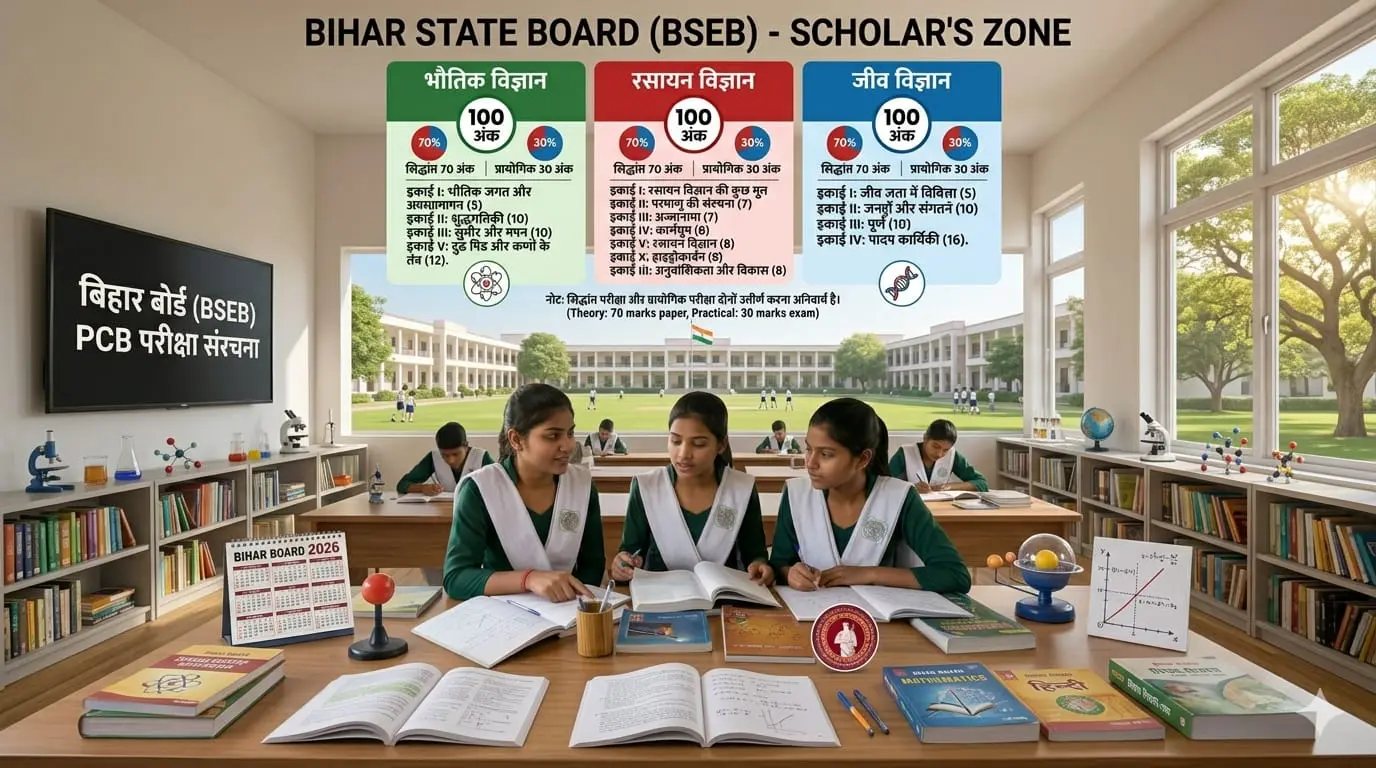
1. PHYSICS SYLLABUS
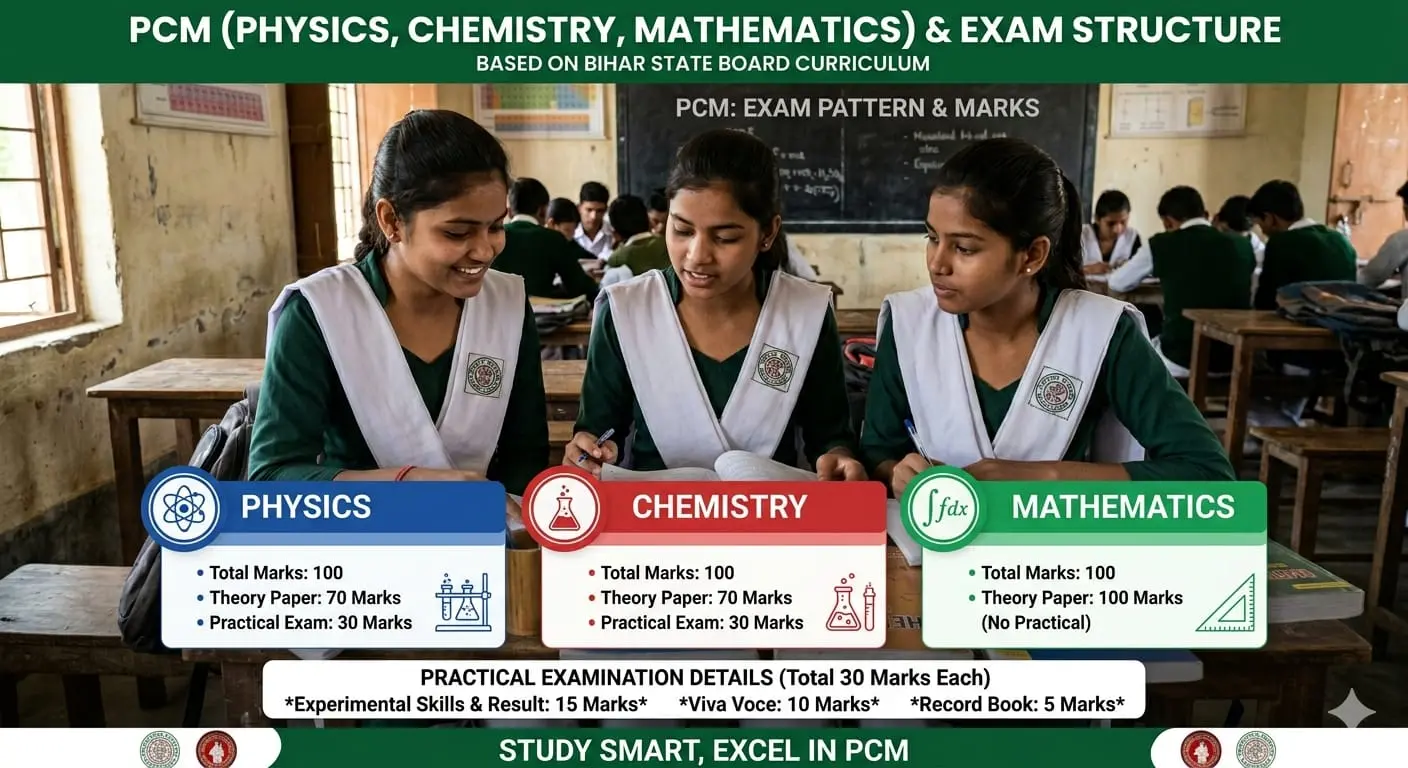
Total Marks: 100 | Theory: 70 Marks | Practicals: 30 Marks
- Unit 1: Electrostatics (स्थिरवैद्युतिकी)
- Core Topics: Electric charges, conservation of charge, and Coulomb's law between two point charges. Electric field, electric field lines, electric dipole, and electric field due to a dipole.
- Key Derivations: Gauss's Theorem and its applications to find fields due to infinitely long straight wire and uniformly charged infinite plane sheet. Electric potential, potential difference, electric potential due to a point charge, and equipotential surfaces. Electrical potential energy of a system of two point charges.
- Capacitance: Conductors and insulators, dielectrics and electric polarization. Capacitors and capacitance, combination of capacitors in series and in parallel, capacitance of a parallel plate capacitor with and without dielectric medium between the plates, and energy stored in a capacitor.
- Unit 2: Current Electricity (धारा विद्युत)
- Core Topics: Electric current, flow of electric charges in a metallic conductor, drift velocity, mobility, and their relation with electric current. Ohm's law, electrical resistance, V-I characteristics (linear and non-linear), electrical energy, and power. Carbon resistors and color coding. Series and parallel combinations of resistors; temperature dependence of resistance.
- Circuits & Instruments: Internal resistance of a cell, potential difference, and EMF (Electromotive Force) of a cell, combination of cells in series and in parallel. Kirchhoff's laws and simple applications. Wheatstone bridge and Metre bridge. Potentiometer: principle and its applications to measure potential difference, comparing EMF of two cells, and measuring internal resistance of a cell.
- Unit 3: Magnetic Effects of Current and Magnetism
- Magnetic Effects: Concept of magnetic field, Oersted's experiment. Biot-Savart law and its application to current carrying circular loop. Ampere's law and its applications to infinitely long straight wire and straight solenoid. Force on a moving charge in uniform magnetic and electric fields (Cyclotron).
- Forces & Current: Force on a current-carrying conductor in a uniform magnetic field. Force between two parallel current-carrying conductors (definition of ampere). Torque experienced by a current loop in a uniform magnetic field; Moving coil galvanometer, its current sensitivity, and conversion to ammeter and voltmeter.
- Magnetism: Current loop as a magnetic dipole and its magnetic dipole moment. Magnetic dipole moment of a revolving electron. Magnetic field intensity due to a magnetic dipole (bar magnet) along its axis and perpendicular to its axis. Torque on a magnetic dipole (bar magnet) in a uniform magnetic field; bar magnet as an equivalent solenoid, magnetic field lines; Earth's magnetic field and magnetic elements. Para-, dia-, and ferro-magnetic substances with examples. Electromagnets and factors affecting their strengths. Permanent magnets.
- Unit 4: Electromagnetic Induction and Alternating Currents
- Electromagnetic Induction: Electromagnetic induction; Faraday's laws, induced EMF and current; Lenz's Law, Eddy currents. Self and mutual induction.
- Alternating Current: Alternating currents, peak and RMS value of alternating current/voltage; reactance and impedance; LCR series circuit, resonance; power in AC circuits, wattless current. AC generator and transformer.
- Unit 5: Electromagnetic Waves (इलेक्ट्रोमैग्नेटिक वेव्स)
- Core Topics: Need for displacement current. Electromagnetic waves and their characteristics, transverse nature of electromagnetic waves.
- Spectrum: Electromagnetic spectrum (radio waves, microwaves, infrared, visible, ultraviolet, X-rays, gamma rays) including elementary facts about their uses.
- Unit 6: Optics (प्रकाशिकी)
- Ray Optics: Reflection of light, spherical mirrors, mirror formula. Refraction of light, total internal reflection and its applications, optical fibers, refraction at spherical surfaces, lenses, thin lens formula, lens maker's formula. Magnification, power of a lens, combination of thin lenses in contact, combination of a lens and a mirror. Refraction and dispersion of light through a prism. Scattering of light: blue color of sky and reddish appearance of the sun at sunrise and sunset.
- Optical Instruments: Optical instruments: Human eye, image formation and accommodation, correction of eye defects (myopia, hypermetropia, presbyopia and astigmatism) using lenses. Microscopes and astronomical telescopes (reflecting and refracting) and their magnifying powers.
- Wave Optics: Wave optics: Wavefront and Huygens' principle, reflection and refraction of plane wave at a plane surface using wave fronts. Proof of laws of reflection and refraction using Huygens' principle. Interference, Young's double slit experiment and expression for fringe width, coherent sources and sustained interference of light. Diffraction due to a single slit, width of central maximum. Resolving power of microscopes and astronomical telescopes. Polarization, plane polarized light; Brewster's law, uses of plane polarized light and Polaroids.
- Unit 7: Dual Nature of Matter and Radiation
- Core Topics: Dual nature of radiation. Photoelectric effect, Hertz and Lenard's observations; Einstein's photoelectric equation-particle nature of light. Matter waves-wave nature of particles, de-Broglie relation. Davisson-Germer experiment.
- Unit 8: Atoms and Nuclei (परमाणु और नाभिक)
- Atoms: Alpha-particle scattering experiment; Rutherford's model of atom; Bohr model, energy levels, hydrogen spectrum.
- Nuclei: Composition and size of nucleus, atomic masses, isotopes, isobars, isotones. Radioactivity-alpha, beta and gamma particles/rays and their properties; radioactive decay law. Mass-energy relation, mass defect; binding energy per nucleon and its variation with mass number; nuclear fission and fusion.
- Unit 9: Electronic Devices (इलेक्ट्रॉनिक उपकरण)
- Core Topics: Energy bands in solids (qualitative ideas only), conductors, insulators, and semiconductors. Semiconductor diode: I-V characteristics in forward and reverse bias, diode as a rectifier.
- Logic Gates: Special purpose p-n junction diodes: LED, photodiode, solar cell, and Zener diode and their characteristics. Zener diode as a voltage regulator. Junction transistor, transistor action, characteristics of a transistor and transistor as an amplifier (common emitter configuration) and oscillator. Logic gates (OR, AND, NOT, NAND and NOR).
- Unit 10: Communication Systems
- Core Topics: Elements of a communication system (block diagram only); bandwidth of signals (speech, TV and digital data); bandwidth of transmission medium. Propagation of electromagnetic waves in the atmosphere, sky and space wave propagation. Need for modulation. Production and detection of an amplitude-modulated wave.
🧪 2. CHEMISTRY SYLLABUS
Total Marks: 100 | Theory: 70 Marks | Practicals: 30 Marks
Physical Chemistry Section
- Solutions (विलयन): Types of solutions, expression of concentration of solutions of solids in liquids, solubility of gases in liquids, solid solutions, colligative properties—relative lowering of vapor pressure, Raoult's law, elevation of boiling point, depression of freezing point, osmotic pressure, determination of molecular masses using colligative properties, abnormal molecular mass, Van't Hoff factor.
- Electrochemistry (वैद्युतरसायन): Redox reactions; conductance in electrolytic solutions, specific and molar conductivity variations of conductivity with concentration, Kohlrausch's Law, electrolysis and laws of electrolysis (elementary idea), dry cell-electrolytic cells and Galvanic cells; lead accumulator, EMF of a cell, standard electrode potential, Nernst equation and its application to chemical cells. Relation between Gibbs energy change and EMF of a cell, fuel cells; corrosion.
- Chemical Kinetics (रासायनिक बलगतिकी): Rate of a reaction (average and instantaneous), factors affecting rates of reaction: concentration, temperature, catalyst; order and molecularity of a reaction; rate law and specific rate constant, integrated rate equations and half-life (only for zero and first-order reactions); concept of collision theory (elementary idea, no mathematical treatment). Activation energy, Arrhenius equation.
Inorganic Chemistry Section
- d and f Block Elements: General introduction, electronic configuration, occurrence and characteristics of transition metals, general trends in properties of the first-row transition metals—metallic character, ionization enthalpy, oxidation states, ionic radii, color, catalytic property, magnetic properties, interstitial compounds, alloy formation. Preparation and properties of $K_2Cr_2O_7$ and $KMnO_4$. Lanthanides: electronic configuration, oxidation states, chemical reactivity, and lanthanide contraction and its consequences. Actinides: Electronic configuration, oxidation states, and comparison with lanthanides.
- Coordination Compounds: Coordination compounds: Introduction, ligands, coordination number, color, magnetic properties and shapes, IUPAC nomenclature of mononuclear coordination compounds, isomerism (structural and stereo) bonding, Werner's theory, VBT (Valence Bond Theory), and CFT (Crystal Field Theory); importance of coordination compounds (in qualitative analysis, extraction of metals and biological systems).
Organic Chemistry Section
- Haloalkanes and Haloarenes: Haloalkanes: Nomenclature, nature of C-X bond, physical and chemical properties, mechanism of substitution reactions ($S_N1$ and $S_N2$ mechanisms), optical rotation. Haloarenes: Nature of C-X bond, substitution reactions (directive influence of halogen for monosubstituted compounds only). Uses and environmental effects of—dichloromethane, trichloromethane, tetrachloromethane, iodoform, freons, DDT.
- Alcohols, Phenols, and Ethers: Alcohols: Nomenclature, methods of preparation, physical and chemical properties (of primary secondary and tertiary alcohols); identification of primary, secondary and tertiary alcohols; mechanism of dehydration, uses, with special reference to methanol and ethanol. Phenols: Nomenclature, methods of preparation, physical and chemical properties, acidic nature of phenol, electrophilic substitution reactions, uses of phenols. Ethers: Nomenclature, methods of preparation, physical and chemical properties, uses.
- Aldehydes, Ketones, and Carboxylic Acids: Aldehydes and Ketones: Nomenclature, nature of carbonyl group, methods of preparation, physical and chemical properties, and mechanism of nucleophilic addition, reactivity of alpha hydrogen in aldehydes; uses. Carboxylic Acids: Nomenclature, acidic nature, methods of preparation, physical and chemical properties; uses.
- Amines (Organic Compounds Containing Nitrogen): Amines: Nomenclature, classification, structure, methods of preparation, physical and chemical properties, uses, identification of primary secondary and tertiary amines. Cyanides and Isocyanides: will be mentioned at relevant places in context. Diazonium salts: Preparation, chemical reactions, and importance in synthetic organic chemistry.
- Biomolecules: Carbohydrates: Classification (aldoses and ketoses), monosaccharides (glucose and fructose), D-L configuration, oligosaccharides (sucrose, lactose, maltose), polysaccharides (starch, cellulose, glycogen): importance. Proteins: Elementary idea of amino acids, peptide bond, polypeptides, proteins, primary structure, secondary structure, tertiary structure and quaternary structure (qualitative idea only), denaturation of proteins; enzymes. Hormones: Elementary idea (excluding structure). Vitamins: Classification and functions. Nucleic Acids: DNA and RNA.
📐 3. MATHEMATICS SYLLABUS
Total Marks: 100 | Theory: 100 Marks (No Practical Exam)
- Unit 1: Relations and Functions
- Relations and Functions: Types of relations: reflexive, symmetric, transitive and equivalence relations. One-to-one and onto functions, composite functions, inverse of a function. Binary operations.
- Inverse Trigonometric Functions: Definition, range, domain, principal value branch. Graphs of inverse trigonometric functions. Elementary properties of inverse trigonometric functions.
- Unit 2: Algebra (बीजगणित)
- Matrices: Concept, notation, order, equality, types of matrices, zero and identity matrix, transpose of a matrix, symmetric and skew-symmetric matrices. Operation on matrices: Addition and multiplication and multiplication with a scalar. Simple properties of addition, multiplication and scalar multiplication. Non-commutativity of multiplication of matrices and existence of non-zero matrices whose product is the zero matrix (restrict to square matrices of order 2). Concept of elementary row and column operations. Invertible matrices and proof of the uniqueness of inverse, if it exists (here all matrices will have real entries).
- Determinants: Determinant of a square matrix (up to 3 by 3 matrices), properties of determinants, minors, co-factors and applications of determinants in finding the area of a triangle. Adjoint and inverse of a square matrix. Consistency, inconsistency and number of solutions of system of linear equations by examples, solving system of linear equations in two or three variables (having unique solution) using inverse of a matrix.
- Unit 3: Calculus (कलन शास्त्र)
- Continuity and Differentiability: Continuity and differentiability, derivative of composite functions, chain rule, derivatives of inverse trigonometric functions, derivative of implicit functions. Concept of exponential and logarithmic functions. Derivatives of logarithmic and exponential functions. Logarithmic differentiation, derivative of functions expressed in parametric forms. Second-order derivatives. Rolle's and Lagrange's Mean Value Theorems (without proof) and their geometric interpretation.
- Applications of Derivatives: Applications of derivatives: rate of change of bodies, increasing/decreasing functions, tangents and normals, use of derivatives in approximation, maxima and minima (first derivative test motivated geometrically and second derivative test given as a provable tool). Simple problems (that illustrate basic principles and understanding of the subject as well as real-life situations).
- Integrals: Integration as inverse process of differentiation. Integration of a variety of functions by substitution, by partial fractions and by parts. Evaluation of simple integrals of standard forms. Definite integrals as a limit of a sum, Fundamental Theorem of Calculus (without proof). Basic properties of definite integrals and evaluation of definite integrals.
- Applications of the Integrals: Applications in finding the area under simple curves, especially lines, circles, parabolas, ellipses (in standard form only). Area between any of the two above-said curves (the region should be clearly identifiable).
- Differential Equations: Definition, order and degree, general and particular solutions of a differential equation. Formation of differential equation whose general solution is given. Solution of differential equations by method of separation of variables, solutions of homogeneous differential equations of first order and first degree. Solutions of linear differential equations of the type: dy/dx + py = q, where p and q are functions of x or constants.
- Unit 4: Vectors and Three-Dimensional Geometry
- Vectors: Vectors and scalars, magnitude and direction of a vector. Direction cosines and direction ratios of a vector. Types of vectors (equal, unit, zero, parallel and collinear vectors), position vector of a point, negative of a vector, components of a vector, addition of vectors, multiplication of a vector by a scalar, position vector of a point dividing a line segment in a given ratio. Definition, Geometrical Interpretation, properties and applications of scalar (dot) product of vectors, vector (cross) product of vectors, scalar triple product of vectors.
- Three-Dimensional Geometry: Direction cosines and direction ratios of a line joining two points. Cartesian equation and vector equation of a line, coplanar and skew lines, shortest distance between two lines. Cartesian and vector equation of a plane. Angle between two lines, two planes, a line and a plane. Distance of a point from a plane.
- Unit 5: Linear Programming (LPP)
- Core Topics: Introduction, related terminology such as constraints, objective function, optimization, different types of linear programming (L.P.) problems, mathematical formulation of L.P. problems, graphical method for solution of problems in two variables, feasible and infeasible regions (bounded or unbounded), feasible and infeasible solutions, optimal feasible solutions (up to three non-trivial constraints).
- Unit 6: Probability (प्रायिकता)
- Core Topics: Conditional probability, multiplication theorem on probability, independent events, total probability, Bayes' theorem, Random variable and its probability distribution, mean and variance of random variable. Repeated independent (Bernoulli) trials and Binomial distribution.

 Bestseller